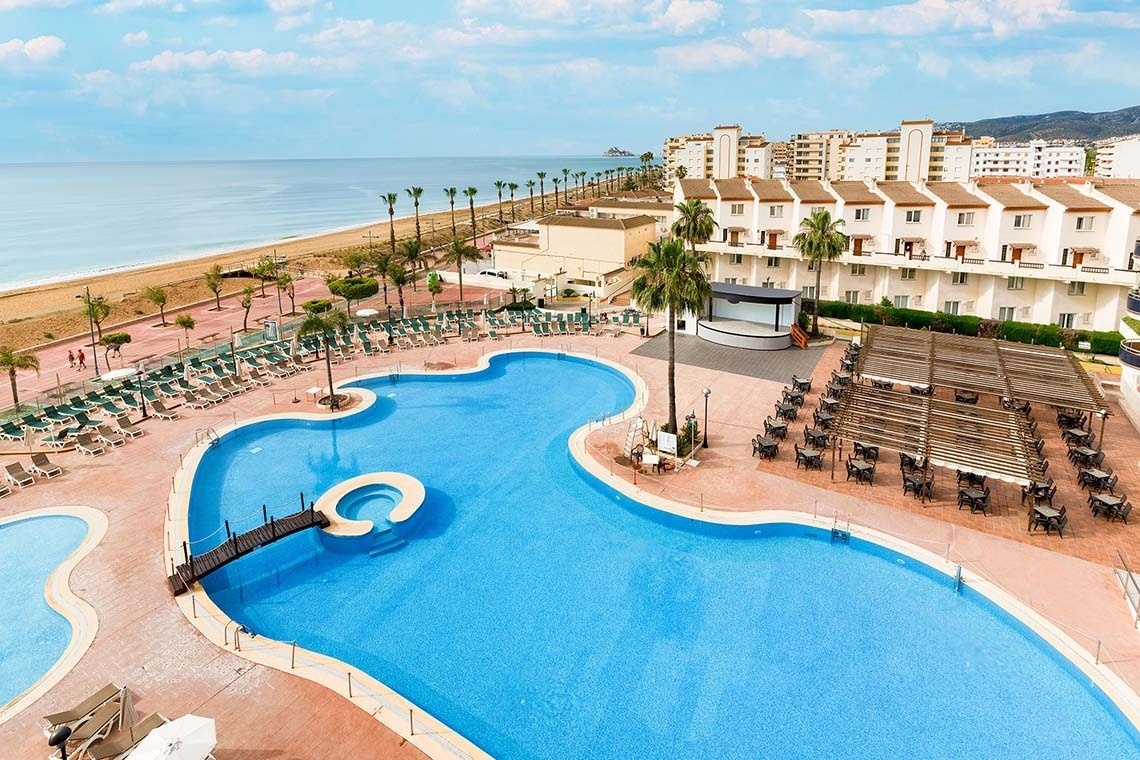
Contact us by email or phone if you have any questions or would like more information about the ZT Hotel & Spa Peñíscola Plaza Suites****.
Read moreRead less
Peñíscola, the city on the sea
The city of Peñíscola is today one of the most important tourist destinations in the Spanish Mediterranean.
It is located 150 km from Valencia and 200 km from Barcelona, perfectly connected by road via the AP-7 motorway and the N-340 national highway, and by plane with the airports of Reus, Valencia, Barcelona and Castellón.
Papa Luna Avenue No. 156, 12598, Peñíscola, Castellón (Spain)
Peñíscola is connected by plane to the airports of Reus, Valencia, Barcelona, and Castellón.
By car
Peñíscola is located 150 km from Valencia and 200 km from Barcelona, with excellent road connections via the AP-7 motorway (take exit 43 towards Benicarló, at the next two roundabouts take the first exit, after about 500 metres you will find the establishment on your left) and the N-340a national road (turn at the roundabout onto Camino de la Ratlla del Terme, at the next roundabout take the first exit, after about 500 metres you will find the establishment on your left).
Peñíscola is located 150 km from Valencia and 200 km from Barcelona, with excellent road connections via the AP-7 motorway (take exit 43 towards Benicarló, at the next two roundabouts take the first exit, after about 500 metres you will find the establishment on your left) and the N-340a national road (turn at the roundabout onto Camino de la Ratlla del Terme, at the next roundabout take the first exit, after about 500 metres you will find the establishment on your left).
Public transport
You can get there by train with Renfe or by bus with AVANZA BUS, which has a stop right in front of the ZT Peñiscola Plaza Suites building.
You can get there by train with Renfe or by bus with AVANZA BUS, which has a stop right in front of the ZT Peñiscola Plaza Suites building.
#ExperienciaZT
Subscribe to our newsletter to receive information about our news, promotions and events.
Thank you for subscribing to our newsletter
Self-consumption photovoltaic installation
This project has been funded by the European Union through the Next Generation EU European Recovery Fund, within the framework of the Recovery, Transformation, and Resilience Plan, promoted by the Ministry for Ecological Transition and the Demographic Challenge.